As two modes of land transportation: railway and road, railway can transport long distances, and the transportation cost will also decrease with the increase of distance and load. Safety is also an essential attribute of rail transport as it is the safest mode of transport after air transport.
Rail transit is a product of the industrial age and plays an important role in the economic development of Western Europe, North America, Japan and China. It represents a major advancement in land transportation technology.
It is not only able to carry heavy loads, but also has higher
universality and speed. Rail transport offers the possibility of
reliable and consistent timetables that can be included in the
planning of economic activities such as production and distribution.
Using containers of the same basic size across the world makes it
easier to transfer between trains of different gauges, thereby
reducing problems caused by incompatible gauge sizes in different
countries. With container trains, economies of scale can be easily
achieved, with the marginal cost of each additional container falling.
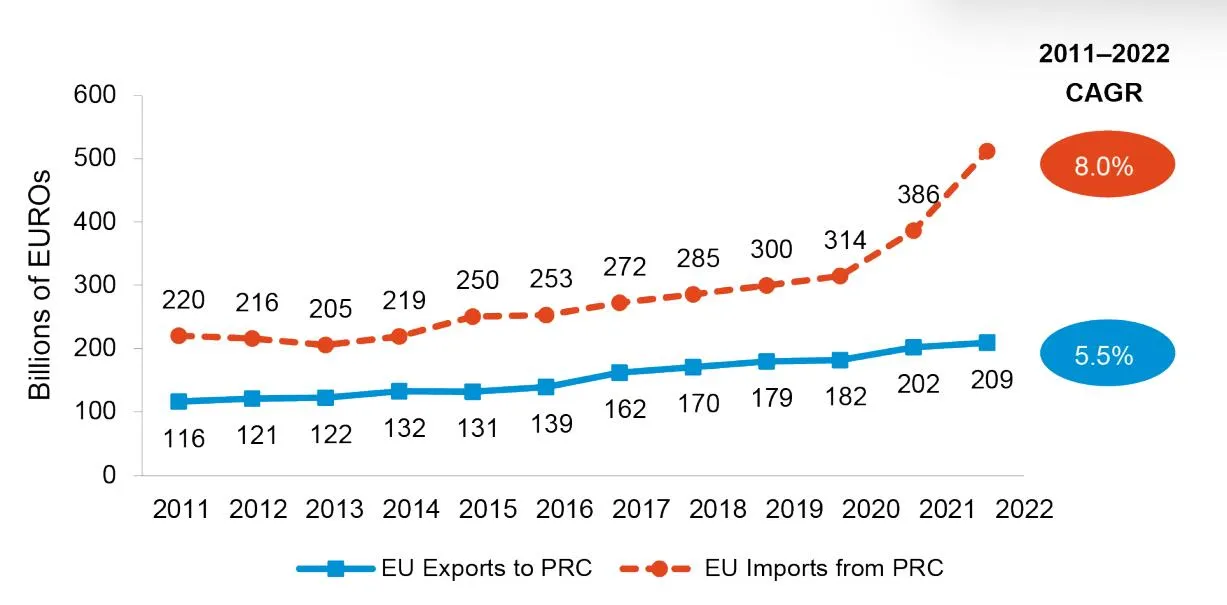
New long-distance alternatives are emerging in the form of land bridges in North America and between Asia and Europe.
- efficiency of the clearance process by customs and other border agencies
- In North America, rail has successfully served the long-distance intermodal market, highlighting rail’s efficiency over long distances and high volumes.
- In Asia, China has deployed a large-scale cross-border investment strategy since 2014, focusing on developing rail corridors between China and Europe, known as the “The Belt and Road”.
As part of its Belt and Road Initiative, China has spent many trillions of dollars (USD) to develop a modern road and rail infrastructure to ship goods not only within China, but into neighboring countries and regions. The freight service and ship times have been improving year by year.
With express services, you get your packages hand-delivered anywhere in the world within 1 week. Sometimes, express cost can be even cheaper than LCL sea shipping.
The Asian-Europe Railway
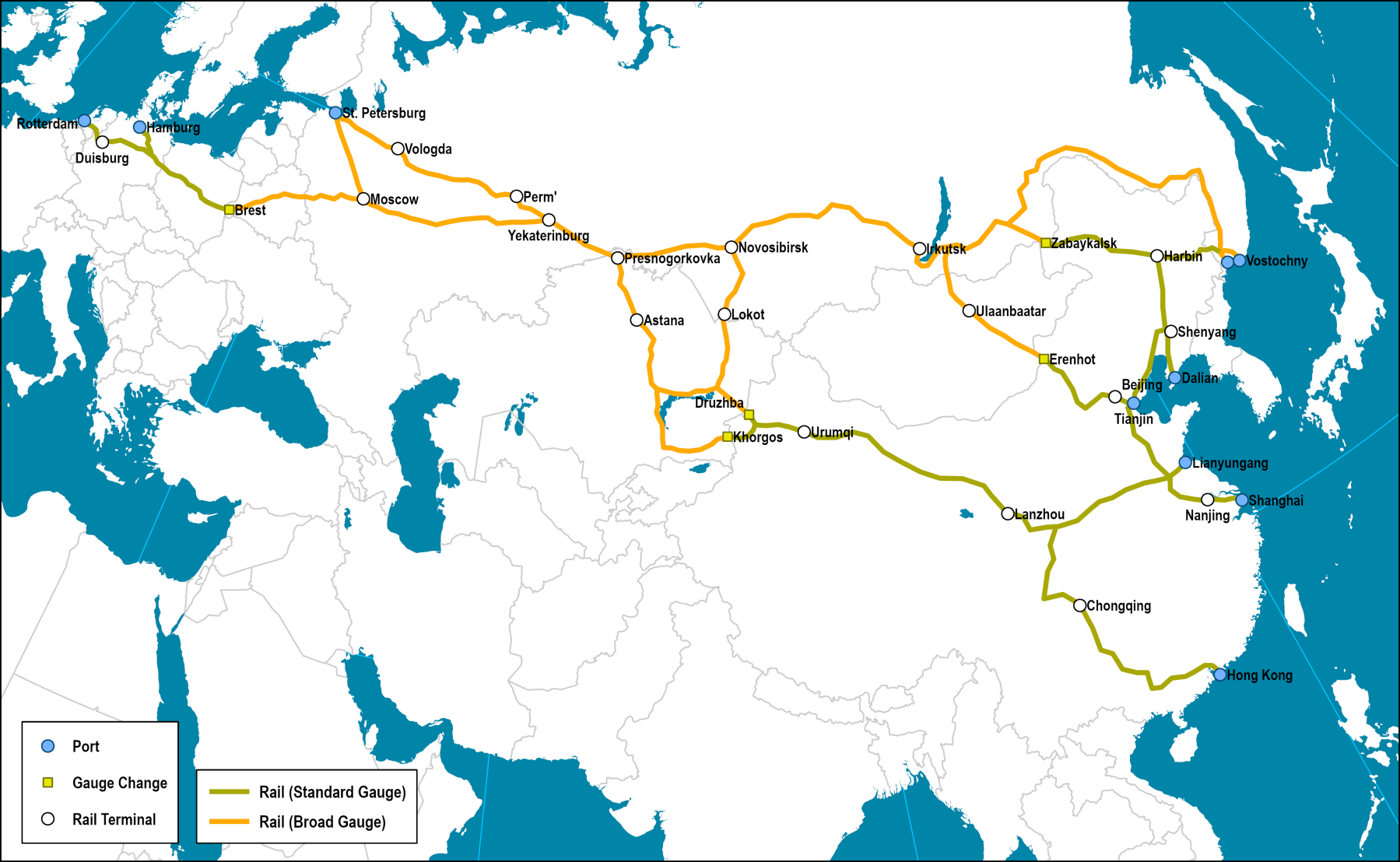
The idea to link the Far East and Europe by rail took its origin with the construction of the Trans Siberian railway linking Moscow to Vladivostok, completed in 1916. With a length of 9,200 km, it is the longest rail segment in the world.
The beginning of the 21st century has brought renewed interest in a long-distance rail connection between Asia and Europe, especially with the booming Asian trade and the increasing pressure to ship containerized freight in a time-sensitive manner over long distances.
These connections came to be known as the Trans Asian Railway, the Northern East-West Corridor, the Eurasian Landbridge, the New Silk Road, OBOR (One Belt One Road; a term used between 2014 and 2017 ) or the BRI (Belt and Road Initiative; a term used since 2017).
The Belt and Road Initiative underlines the importance of China in
shaping the development of these infrastructure and trade corridors.
The main route uses the Trans-Siberian Railway either branching to
Vladivostok with connections to Eastern China, branching to
Kazakhstan, entering western China at Khorgos and Druzhba and then
through the Lanzhou rail hub and onward to the coast of China or
branching into Mongolia to enter China at Erenhot and then to the main
Beijing hub.
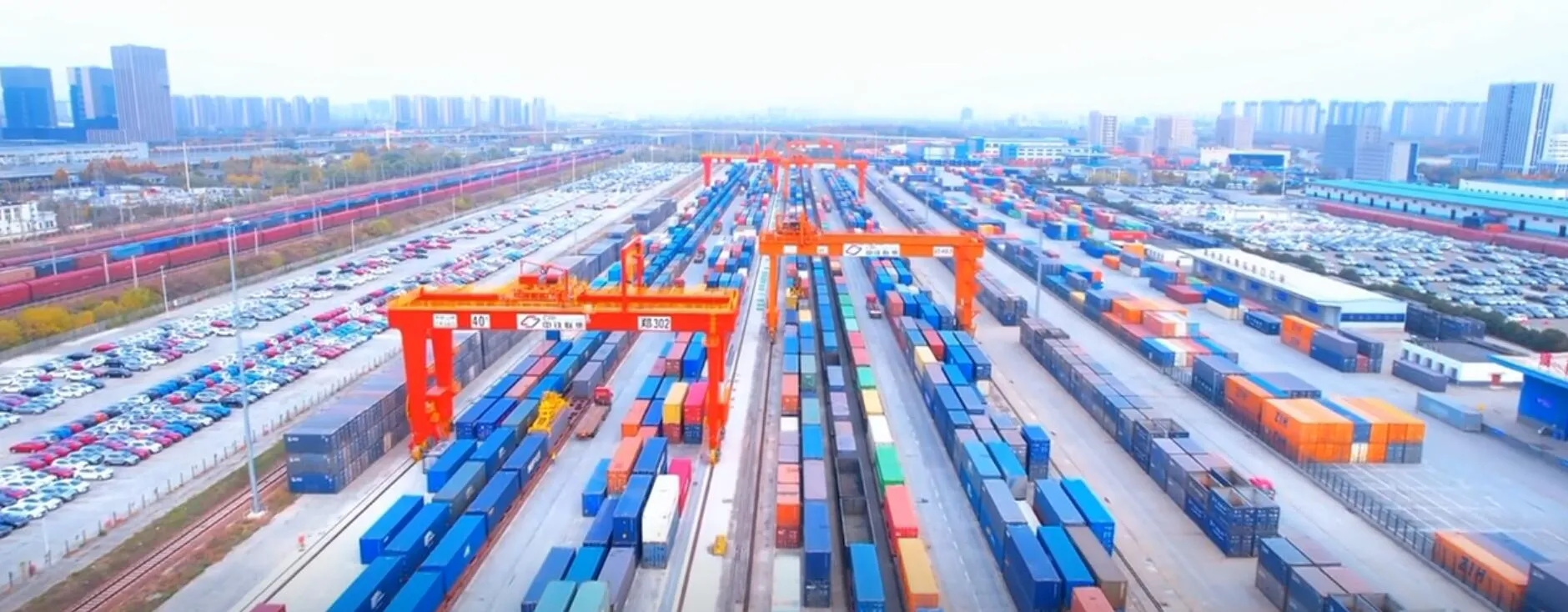
China is seeking to expand trade relations in Central Asia through infrastructure development, including rail connections, inland terminals, and ports.
- In January 2008, a long-distance service called the “Beijing-Hamburg Container Express” was inaugurated, along with a service to Duisburg in 2009. The 10,000 km (6,200 miles) service takes 15 days to link the Chinese capital to the German port city, going through Mongolia, the Russian Federation, Belarus, and Poland. The maritime journey covering the same markets would take about 30 days.
- In 2014 the longest commercial rail service in the world was achieved when a train carrying 82 containers traveled from the city of Yiwu (a major manufacturing cluster in Zhejiang Province) to Madrid, a journey of 12,800 km that took 21 days.
- In 2017, the first service between Yiwu and London using the channel tunnel took 16 days. Since then, regular rail services have been established between China and several European cities.
- On November 15, 2024, the 100,000th China-Europe freight train departed from Chongqing and headed for Duisburg, Germany.
.webp)
China-Europe Railway Express

China Railway Express operates in accordance with fixed train numbers, routes, schedules and full operation timetables, which is the international intermodal train for containers between China and Europe and countries in between.
The economic landscape in China is undergoing a transformative shift, marked by the relocation of production from coastal to central and western provinces. This shift demands an efficient intercontinental transportation mode to overcome inland bottlenecks, a role CR Express adeptly fulfills.
Furthermore, CR Express directly supports China’s economic evolution, aiding the transition from low value-added manufacturing to the production of higher-value goods. These goods require a delivery mode that is faster and more reliable than maritime but more cost-effective than air transportation.
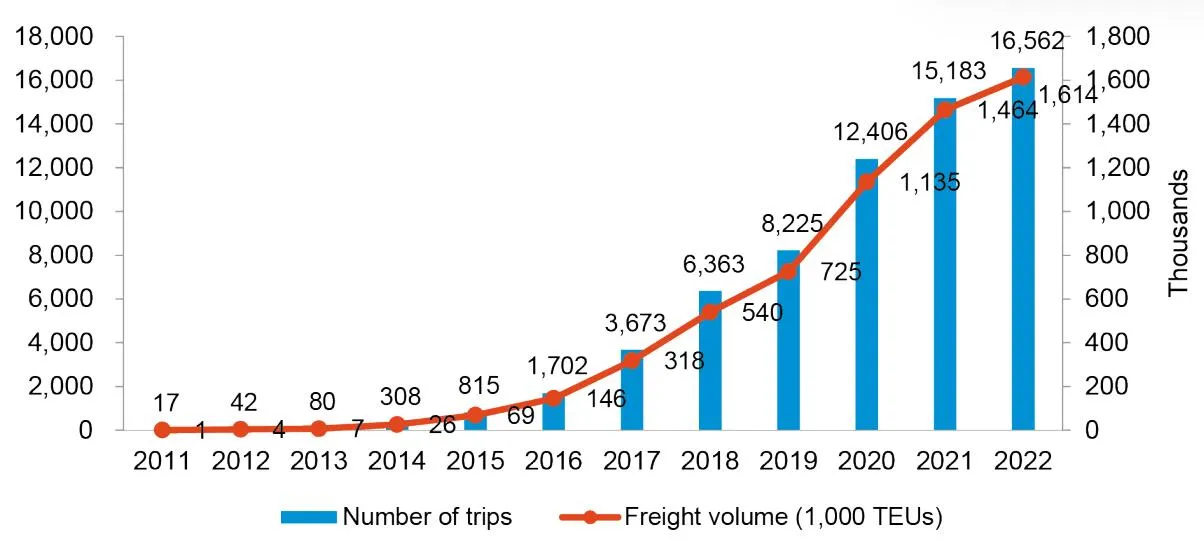
In 2024, a total of 19,392 China-Europe trains have operated throughout the year, including 10,546 outbound trains and 8,846 return trains. The return train ratio is 45.6%. This data highlights the increasingly critical position of China-Europe trains in the field of international logistics and transportation. rail freight long train China Railway Express has implemented measures to expand and increase tonnage and raise the maximum length and traction weight of the trains. For example, the China Railway Express running at a speed of 120 kilometers per hour has carriages of up to 55 and traction weight of up to 3,000 tons.
Due to historical and political reasons, different countries and regions have adopted different railway gauges, standard gauge (1.435 m; China and most of Western Europe) and broad gauge (1.520 m; Russia and some Scandinavian countries).
Transporting goods between China and Europe will involve two gauge changes. The first included the conversion from Chinese standard gauge to Russian broad gauge. The second involved the conversion from Russian broad gauge to European standard gauge. Each time the track gauge changes, containers are transferred side by side from one train to another in a channel-like facility.
Rail Freight Main Routes
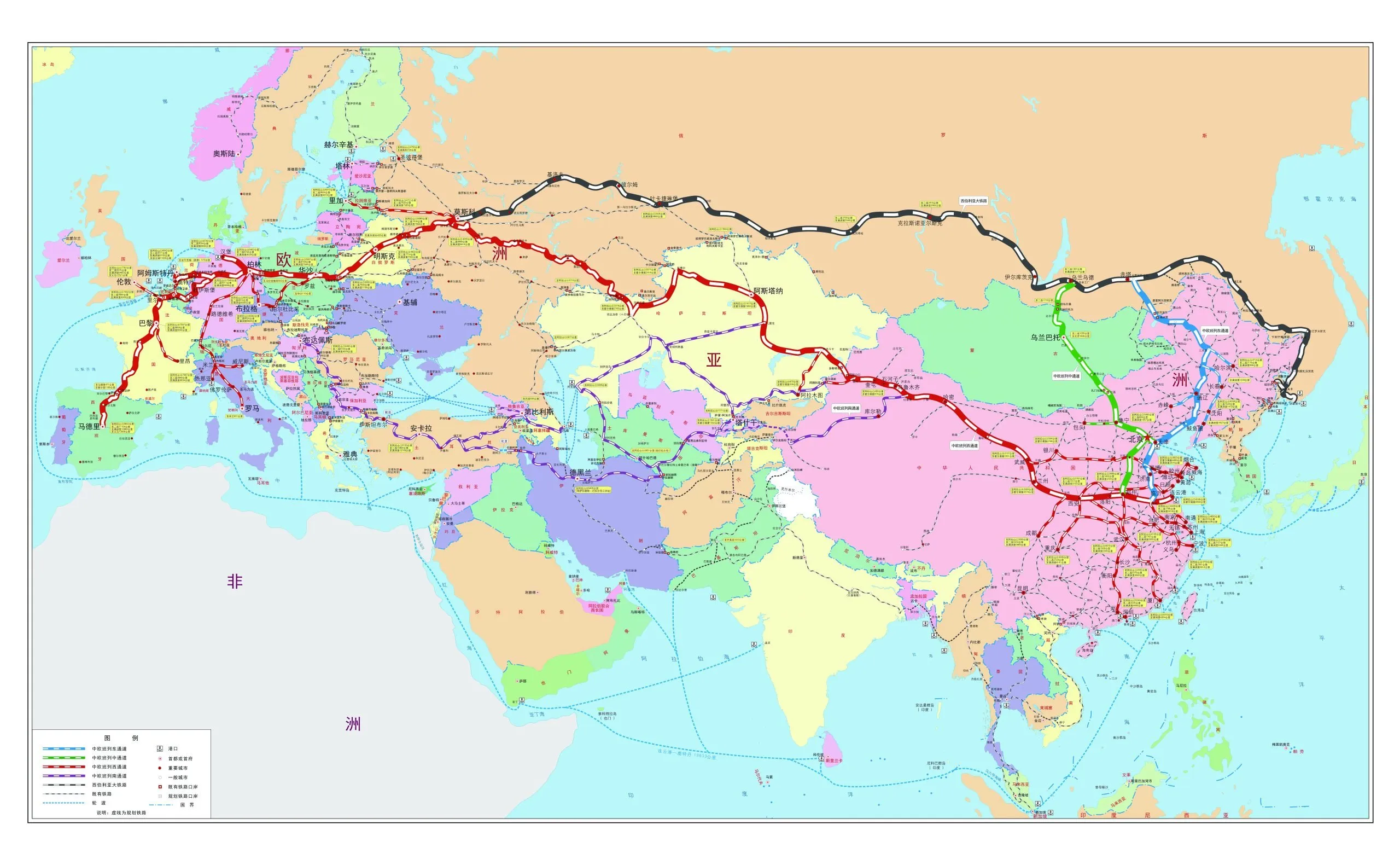
China’s top 6 major border stations for China-Europe are: Alashankou,
Huoerguosi, Manzhouli, Erlian, Suifenhe, Tongjiangbei.
China’s top 6 major border stations for China-Asia are: Huoerguosi,
Mohan, Alashankou, Erlian, Pingxiang, Shanyao.
China’s top 10 major departure stations are: Xi’an, Chengdu,
Chongqing, Zhengzhou, Yiwu, Changsha, Guangzhou, Wuhan, Shenyang,
Jinan.
| Air | Rail | Road | |
|---|---|---|---|
| Time | 3-5 days | 15-18 days | 12 days in Summer, 15 days in Winter |
| Cost | 3 EUR/KG in off season, 5 EUR/KG in peak season | 1.5 EUR/KG | 2.5 EUR/KG |
| Reliability | Stable | Stable | Less stable |
InterSecure can be your one-stop railway logistics partner, from the very beginning to the very end.
- International trade train
- International express train
- International cold-chain train
- International cold-chain train
- International e-commerce train
In ancient times, there was the Silk Road trade camel caravan, and now there is the China-Europe Express “Steel Camel Caravan.” Compared with the current maritime transportation situation, China freight trains have the advantages of fast timeliness, safer transportation process, and more reasonable cost.
You can use overland transportation to create a more cost-effective, reliable distribution solution. Ready to cut costs and streamline your supply chain process? Request a quote and take the first step toward a streamlined future.
Providing exceptional customer service and support, we take our clients through the entire logistical and customs clearance process; continual progress updates providing you with peace of mind and the freedom to pursue your core business activities.